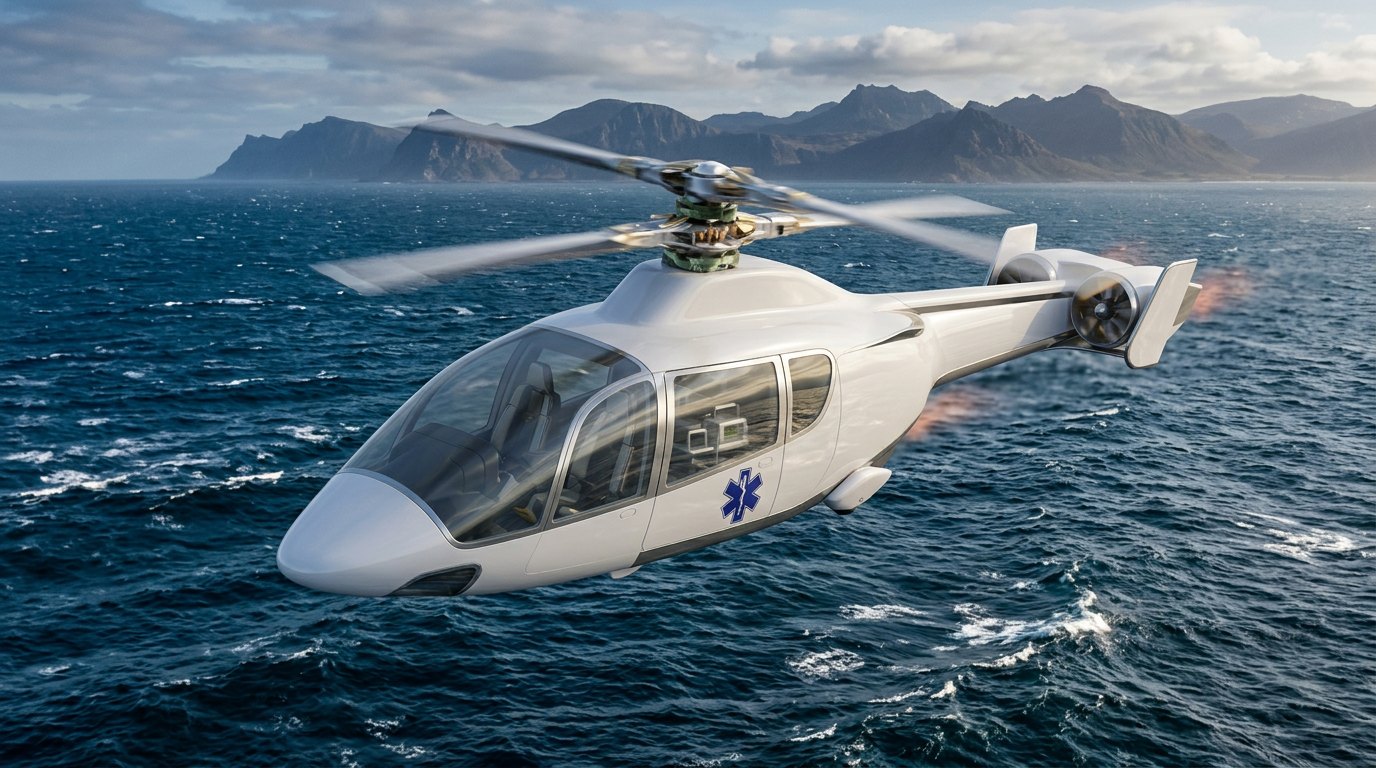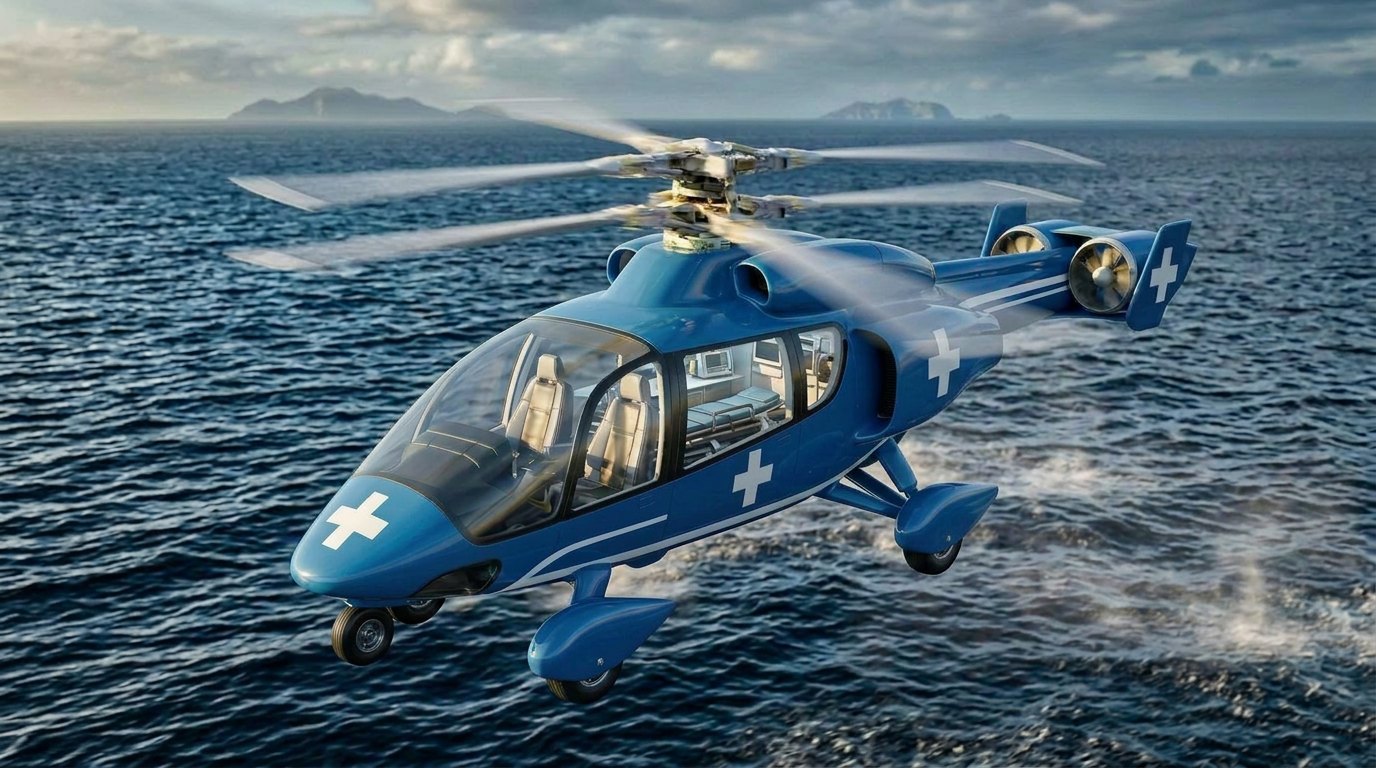

From airframe engineering and rotor systems to the critical-care cabin, certification and connectivity, a plain-English guide to how modern air ambulance aircraft are designed and built.
Key takeaways
- Designing an air ambulance aircraft starts with the mission profile, not a general-purpose airframe.
- Rotor and propulsion architecture is the single biggest driver of safety, cost and efficiency.
- The critical-care cabin is engineered as a certified medical environment, not a retrofit.
- Type certification with the CAA or EASA is a rigorous, multi-year evidence process.
Building an aircraft that carries critically ill patients is one of the more demanding challenges in aviation. It has to be safe enough to fly to unprepared sites in poor weather, clinical enough to serve as a mobile intensive-care unit, and affordable enough to operate at scale. Here is how a modern air ambulance aircraft goes from concept to certified reality.
1. Start with the mission, not the airframe
The first, and most consequential, decision is philosophical. A traditional programme takes an existing helicopter and asks, “how do we fit a stretcher in it?” A next-generation programme inverts the question: “what aircraft does this mission actually need?”
That mission profile is specific: vertical access to constrained sites, a wide weather and terrain envelope, a cabin a crew can work in, low operating cost, and safety built into the aerodynamics. Every later engineering decision is judged against it.
2. Choose the rotor and propulsion architecture
This is where the biggest trade-offs live. A conventional single-main-rotor helicopter needs a tail rotor and a complex, heavily loaded transmission. A hybrid gyroplane-helicopter uses a powered rotor only for take-off and landing and lets it autorotate in cruise, which removes the tail rotor and simplifies the drivetrain.
The architecture chosen here determines the aircraft's safety properties, its fuel burn, its parts count and its maintenance burden for the rest of its life. It is, more than anything else, what separates one air ambulance manufacturer from another.
3. Engineer the airframe and aerodynamics
With an architecture chosen, engineers develop the airframe: aerodynamic surfaces, structural load paths, materials, landing gear and the systems that manage flight. Modern programmes lean heavily on computational fluid dynamics and simulation to validate handling and safety margins long before metal is cut, then confirm the models with wind-tunnel and flight testing.
4. Design the critical-care cabin as a medical environment
The cabin is not an afterthought, it is a certified medical space. Designers work with clinicians to lay out a stretcher-configured interior with:
- secure mounting for monitors, ventilators and infusion pumps;
- medical oxygen and electrical power provisioning;
- space and access for a crew to perform interventions such as intubation, transfusion and CPR in flight;
- lighting, temperature control and infection-control surfaces.
Everything must survive vibration, temperature swings and the forces of flight while remaining usable by a crew under pressure.
5. Integrate connectivity and avionics
Modern aeromedical aircraft are connected. Engineers integrate a resilient communications link so physiological data and audio or video can stream to a remote specialist throughout the mission, the backbone of a modern critical-care cabin. This has to coexist safely with the flight avionics and electromagnetic environment of the aircraft.
6. Prove it: type certification
No air ambulance can carry patients until its design is certified. In the UK and Europe that means a type certificate from the Civil Aviation Authority (CAA) or the European Union Aviation Safety Agency (EASA), a rigorous, evidence-heavy process that scrutinises structural integrity, systems safety, flight characteristics and failure modes. It typically spans years and thousands of pages of substantiation, plus an extensive flight-test campaign.
Certification is where a good design proves it is also a safe one. It is deliberately hard to pass, and that is the point.
7. Manufacture, maintain and support
Once certified, the aircraft enters series production. But manufacturing is only the start of the relationship: a serious manufacturer supports a continued-airworthiness system, spare parts, maintenance schedules, service bulletins and training, that keeps every aircraft in the fleet safe across a service life measured in decades.
Why the architecture choice echoes through everything
If there is one thing to take away, it is that the earliest decision, the rotor and propulsion architecture, shapes cost, safety, sustainability and even the cabin for the entire life of the aircraft. It is why manufacturers willing to start from a clean sheet, rather than adapt an existing helicopter, can deliver an air ambulance that is simultaneously safer, cheaper and cleaner. For a worked example, see how the Avectra 101 applies these principles.